Sickle cell disease: can it be cured, and is a bone marrow transplant right for my child?
Sickle cell disease can be cured by a bone marrow (stem cell) transplant or by gene therapy, said Dr. Arun Singh Danewa, who conducted a Jivo Masterclass on Sickle Cell Disease and Bone Marrow Transplant for international doctors on 2 September 2026. He said hydroxyurea, transfusions and vaccines relieve symptoms without curing. Dr. Dharma Choudhary said transplant is for a selected group of patients, especially those with repeated crises, and Dr. Vikas Dua said any patient with a stroke, chest syndrome or frequent pain crises is a candidate and that sooner is better.
Source: Dr. Arun Singh Danewa (Artemis Hospitals, Gurugram), Jivo Masterclass on Sickle Cell Disease and Bone Marrow Transplant, 2 September 2026, minutes 12 and 13; Dr. Dharma Choudhary (BLK-Max Super Speciality Hospital, New Delhi), Jivo Masterclass on Bone Marrow (Stem Cell) Transplant for Sickle Cell Disease, 7 December 2025, minute 3; Dr. Vikas Dua (Fortis Memorial Research Institute, Gurgaon), Jivo Masterclass on BMT in Sickle Cell Anaemia and Other Haematological Disorders, 28 July 2024, minutes 26 and 27.
What is sickle cell disease, and why does it cause pain?
Dr. Divya Doval explained that sickle cell disease is an inherited anaemia caused by haemoglobin S, which results from a single change in the beta-globin chain of haemoglobin. Dr. Arun Singh Danewa said haemoglobin S makes red cells sticky, so they tangle together and block blood vessels, and blockages in the bones and joints cause severe pain crises. Dr. Sukriti Gupta said sickled cells live only about 20 days, which leaves patients with chronic anaemia and tiredness. Dr. Danewa described it as a chronic, disabling disease that affects every organ of the body and goes well beyond anaemia and pain.
Source: Dr. Divya Doval (BLK-Max Super Speciality Hospital, New Delhi), Jivo Masterclass on Diagnosis and Management of Sickle Cell Disease, 24 November 2024, minute 2; Dr. Arun Singh Danewa (Artemis Hospitals, Gurugram), Jivo Masterclass on Sickle Cell Disease and Bone Marrow Transplant, 2 September 2026, minutes 1, 5, 6 and 7; Dr. Sukriti Gupta (Artemis Hospitals, Gurugram), Jivo Masterclass on Diagnosis and Management of Sickle Cell Disease, 9 November 2025, minutes 8 and 9.
Which parts of the body can sickle cell disease damage over time?
Dr. Arun Singh Danewa said repeated blockages harm the brain through silent infarcts or a full stroke, and repeated small episodes can show up as poor school performance. He explained that after a few years the spleen stops working, which exposes children to serious infections, and that repeated sickling can lead to chronic kidney disease and dialysis. He said avascular necrosis of the hip is a common cause of severe pain and inability to walk. Dr. Sukriti Gupta added that delayed growth is an important sign, and that kidney and heart damage usually appears in adulthood, which is why children are screened early.
Source: Dr. Arun Singh Danewa (Artemis Hospitals, Gurugram), Jivo Masterclass on Sickle Cell Disease and Bone Marrow Transplant, 2 September 2026, minutes 8, 9 and 10; Dr. Sukriti Gupta (Artemis Hospitals, Gurugram), Jivo Masterclass on Diagnosis and Management of Sickle Cell Disease, 9 November 2025, minutes 11 and 13.
Which warning signs mean a patient needs hospital care at once?
Dr. Divya Doval said acute chest syndrome looks like pneumonia, with fever, chest pain, breathlessness, cough and low oxygen, often 24 to 72 hours after a pain episode, and that it is the leading cause of premature death in sickle cell disease. Dr. Sukriti Gupta said abnormal movements, loss of consciousness or weakness point to reduced blood flow to the brain and can be fatal if not managed properly. Dr. Doval described two other emergencies: a young child with pain and fullness in the upper left abdomen, an enlarged spleen and a sudden fall in haemoglobin, and sudden loss of vision. She said a painful erection lasting more than four hours, if severe or repeated, can cause permanent erectile dysfunction.
Source: Dr. Divya Doval (BLK-Max Super Speciality Hospital, New Delhi), Jivo Masterclass on Diagnosis and Management of Sickle Cell Disease, 24 November 2024, minutes 26, 46, 53 and 55; Dr. Sukriti Gupta (Artemis Hospitals, Gurugram), Jivo Masterclass on Diagnosis and Management of Sickle Cell Disease, 9 November 2025, minute 11.
What triggers a crisis, and what helps at home?
Dr. Divya Doval said crises are often triggered by cold, dehydration, infection, fever or any stress on the body, including low oxygen at high altitude. Dr. Arun Singh Danewa said patients and their families should learn these triggers, such as a change in weather and infection. Dr. Sukriti Gupta said good hydration is a must for every child, and Dr. Doval said it really helps anyone having, or about to have, a pain crisis.
Source: Dr. Divya Doval (BLK-Max Super Speciality Hospital, New Delhi), Jivo Masterclass on Diagnosis and Management of Sickle Cell Disease, 24 November 2024, minutes 22, 72 and 76; Dr. Arun Singh Danewa (Artemis Hospitals, Gurugram), Jivo Masterclass on Sickle Cell Disease and Bone Marrow Transplant, 2 September 2026, minute 42; Dr. Sukriti Gupta (Artemis Hospitals, Gurugram), Jivo Masterclass on Diagnosis and Management of Sickle Cell Disease, 9 November 2025, minute 26.
Which tests confirm sickle cell disease?
Dr. Sukriti Gupta said haemoglobin electrophoresis is the most important diagnostic test and is easily available even in low-resource settings. She explained that quick sickling screening tests can give false results, so electrophoresis is always preferred, particularly when there is a family history. Dr. Divya Doval added that the sickle solubility test cannot tell a carrier from a patient with the disease, and that a newborn heel-prick screen needs a confirmatory test such as HPLC or electrophoresis.
Source: Dr. Sukriti Gupta (Artemis Hospitals, Gurugram), Jivo Masterclass on Diagnosis and Management of Sickle Cell Disease, 9 November 2025, minutes 15, 16 and 25; Dr. Divya Doval (BLK-Max Super Speciality Hospital, New Delhi), Jivo Masterclass on Diagnosis and Management of Sickle Cell Disease, 24 November 2024, minutes 13, 14 and 16.
What regular care does a child with sickle cell disease need?
Dr. Sukriti Gupta said children should see a general practitioner or paediatrician every two to three months even without symptoms, take penicillin prophylaxis up to five years of age, and receive flu and pneumococcal vaccines. She advised a first transcranial Doppler scan of the brain vessels at two years of age to pick up stroke risk early, repeated every six months to a year if it is normal. Dr. Divya Doval cited ASH 2020 guidance for a transcranial Doppler every year from age 2 to 16 in children with HbSS and HbS beta-zero disease, and she listed a yearly eye examination as part of general care.
Source: Dr. Sukriti Gupta (Artemis Hospitals, Gurugram), Jivo Masterclass on Diagnosis and Management of Sickle Cell Disease, 9 November 2025, minutes 22, 23 and 26; Dr. Divya Doval (BLK-Max Super Speciality Hospital, New Delhi), Jivo Masterclass on Diagnosis and Management of Sickle Cell Disease, 24 November 2024, minutes 40 and 61.
If both parents carry sickle cell trait, what is the chance our child has the disease?
Dr. Divya Doval explained that when both parents are carriers, each child has a 25% chance of the disease, a 50% chance of being a carrier and a 25% chance of being unaffected. Dr. Arun Singh Danewa said that if only one parent carries the gene, the baby will not have the disease but may be a carrier. Dr. Doval said carriers do not have the disease and live a normal lifespan, and Dr. Danewa said they can occasionally have milder symptoms in extreme conditions such as high altitude, cold, stress or infection. Dr. Sukriti Gupta advised that once one person in a family is diagnosed, siblings and parents should be screened, and Dr. Doval said marriage between relatives raises the chance that both partners are carriers.
Source: Dr. Divya Doval (BLK-Max Super Speciality Hospital, New Delhi), Jivo Masterclass on Diagnosis and Management of Sickle Cell Disease, 24 November 2024, minutes 4, 10 and 94; Dr. Arun Singh Danewa (Artemis Hospitals, Gurugram), Jivo Masterclass on Sickle Cell Disease and Bone Marrow Transplant, 2 September 2026, minutes 4 and 57; Dr. Sukriti Gupta (Artemis Hospitals, Gurugram), Jivo Masterclass on Diagnosis and Management of Sickle Cell Disease, 9 November 2025, minute 17.
What should a couple know about sickle cell disease and pregnancy?
Dr. Sukriti Gupta said that when both parents are confirmed carriers, chorionic villus sampling at 9 to 11 weeks or amniocentesis at around 16 weeks allows a genetic test of the expected baby, and she advised genetic counselling in advance. Dr. Divya Doval said pregnancy carries high risks for a mother with sickle cell disease and her baby, and a crisis during labour can be very difficult to manage, so every woman with sickle cell disease should be counselled before starting a family. She said hydroxyurea should ideally be stopped, with the treating doctor, when a man or woman taking it plans a pregnancy, because it can harm the baby and must not be taken at least in the first three months, and because in men it can reduce sperm count and motility.
Source: Dr. Sukriti Gupta (Artemis Hospitals, Gurugram), Jivo Masterclass on Diagnosis and Management of Sickle Cell Disease, 9 November 2025, minutes 18 and 19; Dr. Divya Doval (BLK-Max Super Speciality Hospital, New Delhi), Jivo Masterclass on Diagnosis and Management of Sickle Cell Disease, 24 November 2024, minutes 64 and 84.
Can sickle cell disease be cured?
Dr. Arun Singh Danewa said in September 2026 that the curative options are a bone marrow transplant and gene therapy, and that vaccines, antibiotics, transfusions and hydroxyurea relieve symptoms for a time without curing. Dr. Dharma Choudhary described transplant as the established cure and gene therapy as the only other curative option, and Dr. Divya Doval noted that gene therapy was approved by the US FDA in December 2023. Dr. Danewa added that new symptom-relieving medicines will not replace transplant, because silent complications continue while sickling goes on.
Source: Dr. Arun Singh Danewa (Artemis Hospitals, Gurugram), Jivo Masterclass on Sickle Cell Disease and Bone Marrow Transplant, 2 September 2026, minutes 12, 13 and 43; Dr. Dharma Choudhary (BLK-Max Super Speciality Hospital, New Delhi), Jivo Masterclass on Bone Marrow (Stem Cell) Transplant for Sickle Cell Disease, 7 December 2025, minute 2; Dr. Divya Doval (BLK-Max Super Speciality Hospital, New Delhi), Jivo Masterclass on Diagnosis and Management of Sickle Cell Disease, 24 November 2024, minute 62.
What does hydroxyurea do?
Dr. Dharma Choudhary said hydroxyurea raises fetal haemoglobin and reduces the number of crises, and Dr. Divya Doval said it also reduces chest crises, blood transfusions and hospital admissions. Dr. Arun Singh Danewa said hydroxyurea should be part of every patient's treatment, and Dr. Sukriti Gupta said doctors can start it as soon as the disease is detected, as young as two months of age, though how much it helps varies from person to person. Dr. Doval noted that voxelotor (Oxbryta) was voluntarily withdrawn by Pfizer in September 2024 over safety concerns.
Source: Dr. Dharma Choudhary (BLK-Max Super Speciality Hospital, New Delhi), Jivo Masterclass on Bone Marrow (Stem Cell) Transplant for Sickle Cell Disease, 7 December 2025, minute 2; Dr. Divya Doval (BLK-Max Super Speciality Hospital, New Delhi), Jivo Masterclass on Diagnosis and Management of Sickle Cell Disease, 24 November 2024, minutes 62 and 66; Dr. Arun Singh Danewa (Artemis Hospitals, Gurugram), Jivo Masterclass on Sickle Cell Disease and Bone Marrow Transplant, 2 September 2026, minute 38; Dr. Sukriti Gupta (Artemis Hospitals, Gurugram), Jivo Masterclass on Diagnosis and Management of Sickle Cell Disease, 9 November 2025, minutes 33 and 44.
How is gene therapy different from a bone marrow transplant?
Dr. Sukriti Gupta explained that gene therapy needs no donor: the patient's own stem cells are collected, modified in a laboratory, which currently takes around six months, and returned after chemotherapy. Dr. Arun Singh Danewa said that because the cells are the patient's own, graft versus host disease and other complications are much less likely. Dr. Divya Doval said the barriers are very high cost, loss of fertility and a risk of later cancer from the chemotherapy. Dr. Gupta said in November 2025 that approved gene therapies are for people aged 12 and older and are available in the US, European countries, Switzerland, Saudi Arabia and Bahrain.
Source: Dr. Sukriti Gupta (Artemis Hospitals, Gurugram), Jivo Masterclass on Diagnosis and Management of Sickle Cell Disease, 9 November 2025, minutes 56, 57 and 59; Dr. Arun Singh Danewa (Artemis Hospitals, Gurugram), Jivo Masterclass on Sickle Cell Disease and Bone Marrow Transplant, 2 September 2026, minute 37; Dr. Divya Doval (BLK-Max Super Speciality Hospital, New Delhi), Jivo Masterclass on Diagnosis and Management of Sickle Cell Disease, 24 November 2024, minute 71.
Should we wait for gene therapy or choose a transplant?
Dr. Sukriti Gupta said she expects gene therapy to become the preferred treatment once its cost comes down, and that where money is a concern she prefers a bone marrow transplant, which has mature data and excellent results in experienced hands. She added that a patient with recent severe crises or a stroke-like episode cannot wait six to eight months for gene therapy, and that whichever treatment is chosen must be seen through to the end. Dr. Arun Singh Danewa said that if a cure is affordable and available it should be chosen, and otherwise good supportive treatment gives a good quality of life.
Source: Dr. Sukriti Gupta (Artemis Hospitals, Gurugram), Jivo Masterclass on Diagnosis and Management of Sickle Cell Disease, 9 November 2025, minutes 62, 64, 65 and 66; Dr. Arun Singh Danewa (Artemis Hospitals, Gurugram), Jivo Masterclass on Sickle Cell Disease and Bone Marrow Transplant, 2 September 2026, minute 43.
Does every patient need a transplant, and who should be considered?
Dr. Dharma Choudhary said the disease varies, with some patients silent or having one crisis a year, so transplant is for a selected group, especially those with recurrent crises. He said patients without symptoms or with mild disease need no curative treatment, because every treatment carries a risk of illness and death. Dr. Sukriti Gupta said any stroke is an absolute indication, and that other indications include acute chest syndrome (especially two episodes), dependence on transfusions and painful crises needing hospital care more than three times a year. Dr. Divya Doval said her centre considers any child with a single stroke, a single chest crisis or several pain episodes needing admission. Dr. Choudhary advised taking patients for transplant after even a single neurological complication, and considering those with constant hospital admissions, recurrent infection or avascular necrosis whatever the donor type.
Source: Dr. Dharma Choudhary (BLK-Max Super Speciality Hospital, New Delhi), Jivo Masterclass on Bone Marrow (Stem Cell) Transplant for Sickle Cell Disease, 7 December 2025, minutes 3, 6, 12 and 40; Dr. Sukriti Gupta (Artemis Hospitals, Gurugram), Jivo Masterclass on Diagnosis and Management of Sickle Cell Disease, 9 November 2025, minute 37; Dr. Divya Doval (BLK-Max Super Speciality Hospital, New Delhi), Jivo Masterclass on Diagnosis and Management of Sickle Cell Disease, 24 November 2024, minute 73.
What is the right age for a transplant, and can adults have one?
The specialists differ on the youngest age: Dr. Arun Singh Danewa said transplant is possible from one year and that two to five years is the ideal age, while Dr. Dharma Choudhary said it is better offered after two years, because very young children may have had only one crisis and cannot tolerate proper immunosuppression. Dr. Danewa said the chances of success fall after 14 or 15, because repeated sickling has already affected the organs. On adults, Dr. Choudhary and Dr. Divya Doval said there is no upper age limit, with Dr. Doval noting that risk rises with age, and Dr. Danewa said organ damage matters more than age and he transplants adults around 30 who have good organ function and a full-match sibling donor.
Source: Dr. Arun Singh Danewa (Artemis Hospitals, Gurugram), Jivo Masterclass on Sickle Cell Disease and Bone Marrow Transplant, 2 September 2026, minutes 23, 55 and 76; Dr. Dharma Choudhary (BLK-Max Super Speciality Hospital, New Delhi), Jivo Masterclass on Bone Marrow (Stem Cell) Transplant for Sickle Cell Disease, 7 December 2025, minute 41; Dr. Divya Doval (BLK-Max Super Speciality Hospital, New Delhi), Jivo Masterclass on Diagnosis and Management of Sickle Cell Disease, 24 November 2024, minute 80.
Who cannot have a transplant?
Dr. Dharma Choudhary said patients with failure of the liver, kidneys, lungs or heart, or a severe stroke with paralysis, are not transplant candidates. Dr. Arun Singh Danewa said a transplant needs good kidney function to handle the drugs, which is why the kidneys are checked beforehand. Dr. Sukriti Gupta said a transplant is most likely to succeed in a younger patient with well-preserved organ function and a suitable donor, and that the patient's family and the team must understand the financial implications.
Source: Dr. Dharma Choudhary (BLK-Max Super Speciality Hospital, New Delhi), Jivo Masterclass on Bone Marrow (Stem Cell) Transplant for Sickle Cell Disease, 7 December 2025, minute 42; Dr. Arun Singh Danewa (Artemis Hospitals, Gurugram), Jivo Masterclass on Sickle Cell Disease and Bone Marrow Transplant, 2 September 2026, minute 78; Dr. Sukriti Gupta (Artemis Hospitals, Gurugram), Jivo Masterclass on Diagnosis and Management of Sickle Cell Disease, 9 November 2025, minute 38.
Who can be the donor for a sickle cell transplant?
Dr. Arun Singh Danewa said the first step is high-resolution HLA typing of the patient and the possible donors, and a brother or sister who matches on all 10 HLA markers is a matched sibling donor. He said each sibling has about a 25% chance of being a full match, and a fully matched sibling who carries sickle cell trait can still donate. Dr. Sukriti Gupta said aunts, uncles and cousins are usually not even a half match.
Source: Dr. Arun Singh Danewa (Artemis Hospitals, Gurugram), Jivo Masterclass on Sickle Cell Disease and Bone Marrow Transplant, 2 September 2026, minutes 14, 15, 16 and 20; Dr. Sukriti Gupta (Artemis Hospitals, Gurugram), Jivo Masterclass on Diagnosis and Management of Sickle Cell Disease, 9 November 2025, minute 69.
Can a parent be the donor if no brother or sister matches?
Dr. Vikas Dua said a half-match (haploidentical) transplant can use the father or mother as donor, because half of a child's genes come from each parent, with good outcomes. He said Africans are under-represented in worldwide donor registries, so for an African patient without a full match in the family the option left is a half-match transplant from a parent, and the parents should travel to India with the patient, as they can serve as half-match donors. Dr. Sukriti Gupta said parents who do not have sickle cell disease themselves and have no organ problems or major illness such as HIV are good half-match donors. Dr. Arun Singh Danewa said the patient must test negative for antibodies against the donor (DSA) before a half-match transplant.
Source: Dr. Vikas Dua (Fortis Memorial Research Institute, Gurgaon), Jivo Masterclass on BMT in Sickle Cell Anaemia and Other Haematological Disorders, 28 July 2024, minutes 17, 37, 49 and 50; Dr. Sukriti Gupta (Artemis Hospitals, Gurugram), Jivo Masterclass on Diagnosis and Management of Sickle Cell Disease, 9 November 2025, minute 68; Dr. Arun Singh Danewa (Artemis Hospitals, Gurugram), Jivo Masterclass on Sickle Cell Disease and Bone Marrow Transplant, 2 September 2026, minute 18.
Is a half-match transplant as good as a full match?
The specialists differ. Dr. Dharma Choudhary said in December 2025 that half-match results are now almost equal to matched sibling transplant. Dr. Sukriti Gupta said in November 2025 that complications are more frequent with half-match or unrelated donors and that a full-match sibling is always the preferred donor. Dr. Arun Singh Danewa said a donor below a 50% match is not accepted, and that above 50% the outcome is the same whether the match is 60% or 90%, so a donor counts as either a full match or a half match. Dr. Vikas Dua said every family and doctor should understand that a transplant can still be done with good outcomes when nobody is a full match.
Source: Dr. Dharma Choudhary (BLK-Max Super Speciality Hospital, New Delhi), Jivo Masterclass on Bone Marrow (Stem Cell) Transplant for Sickle Cell Disease, 7 December 2025, minute 4; Dr. Sukriti Gupta (Artemis Hospitals, Gurugram), Jivo Masterclass on Diagnosis and Management of Sickle Cell Disease, 9 November 2025, minute 49; Dr. Arun Singh Danewa (Artemis Hospitals, Gurugram), Jivo Masterclass on Sickle Cell Disease and Bone Marrow Transplant, 2 September 2026, minute 18; Dr. Vikas Dua (Fortis Memorial Research Institute, Gurgaon), Jivo Masterclass on BMT in Sickle Cell Anaemia and Other Haematological Disorders, 28 July 2024, minute 38.
What does the donor go through?
Dr. Sukriti Gupta said the donor receives stem cell booster injections for four days and the cells are collected from the blood on the fifth day, without puncturing the bone marrow. Dr. Arun Singh Danewa said the collection is done by a machine, like a platelet donation, through a line in the neck or groin, with no cut, no anaesthesia and no surgery, as a daycare procedure. He said anyone over one year of age or 10 kg can practically donate.
Source: Dr. Sukriti Gupta (Artemis Hospitals, Gurugram), Jivo Masterclass on Diagnosis and Management of Sickle Cell Disease, 9 November 2025, minute 45; Dr. Arun Singh Danewa (Artemis Hospitals, Gurugram), Jivo Masterclass on Sickle Cell Disease and Bone Marrow Transplant, 2 September 2026, minutes 24 and 26.
What happens during the transplant?
Dr. Arun Singh Danewa said the patient and donor first have blood tests and scans to check that the kidneys and heart work normally, that there is no brain infarct, and that there is no infection or dental decay. He said conditioning chemotherapy then clears the old sickle marrow, and Dr. Sukriti Gupta said the donor stem cells are given through a normal vein like a blood transfusion. Both said a bone marrow transplant is a medical procedure with no cutting and is not surgery. Dr. Gupta said engraftment, when the donor cells settle in the marrow and start making healthy blood cells, is the most important step.
Source: Dr. Arun Singh Danewa (Artemis Hospitals, Gurugram), Jivo Masterclass on Sickle Cell Disease and Bone Marrow Transplant, 2 September 2026, minutes 21, 25 and 28; Dr. Sukriti Gupta (Artemis Hospitals, Gurugram), Jivo Masterclass on Diagnosis and Management of Sickle Cell Disease, 9 November 2025, minutes 37, 46 and 47.
What are the main risks of the transplant?
Dr. Sukriti Gupta said the main complications are infections, graft versus host disease, graft failure that can let the disease return, and organ damage from the chemotherapy. Dr. Arun Singh Danewa said the new stem cells are immature at handling infection, so the first 30, 60 and 100 days are crucial. Dr. Dharma Choudhary explained that the success rates doctors quote describe groups of 100 patients, while for one patient the outcome is either a cure or not. Dr. Danewa said all complications and expectations should be discussed honestly and in writing before consent.
Source: Dr. Sukriti Gupta (Artemis Hospitals, Gurugram), Jivo Masterclass on Diagnosis and Management of Sickle Cell Disease, 9 November 2025, minute 48; Dr. Arun Singh Danewa (Artemis Hospitals, Gurugram), Jivo Masterclass on Sickle Cell Disease and Bone Marrow Transplant, 2 September 2026, minutes 31 and 78; Dr. Dharma Choudhary (BLK-Max Super Speciality Hospital, New Delhi), Jivo Masterclass on Bone Marrow (Stem Cell) Transplant for Sickle Cell Disease, 7 December 2025, minute 43.
Will a transplant affect fertility?
Dr. Dharma Choudhary said infertility is very common after transplant, so wherever possible semen or eggs are collected beforehand. Dr. Arun Singh Danewa said fertility must be discussed before every transplant: sperm banking is easy for boys who have reached puberty, egg preservation for girls needs a procedure, and adolescents should try preservation before coming to India. On sexual function the specialists differ: Dr. Choudhary said it is not affected, while Dr. Danewa said sexual problems can follow transplant, although the risk is much lower with newer drugs.
Source: Dr. Dharma Choudhary (BLK-Max Super Speciality Hospital, New Delhi), Jivo Masterclass on Bone Marrow (Stem Cell) Transplant for Sickle Cell Disease, 7 December 2025, minutes 32 and 38; Dr. Arun Singh Danewa (Artemis Hospitals, Gurugram), Jivo Masterclass on Sickle Cell Disease and Bone Marrow Transplant, 2 September 2026, minutes 35, 53 and 54.
What decides the cost of a transplant?
Dr. Arun Singh Danewa said cost depends on the patient's age and other illnesses, because a younger child needs lower drug doses and has fewer complications. Dr. Dharma Choudhary said medicines cost about the same everywhere, and India's lower cost compared with the US or Europe comes from lower bed charges and supportive care. He said some centres short of resources leave out ATG, an expensive medicine, to reduce cost, which increases the risk of graft versus host disease. Dr. Danewa said lifelong hospital and drug costs add up to about the cost of a transplant, which needs the money at one time.
Source: Dr. Arun Singh Danewa (Artemis Hospitals, Gurugram), Jivo Masterclass on Sickle Cell Disease and Bone Marrow Transplant, 2 September 2026, minutes 24, 34 and 44; Dr. Dharma Choudhary (BLK-Max Super Speciality Hospital, New Delhi), Jivo Masterclass on Bone Marrow (Stem Cell) Transplant for Sickle Cell Disease, 7 December 2025, minutes 46 and 50.
Cost pages for each transplant type: Matched Sibling/Family Donor BMT, Unrelated Donor BMT, Haploidentical (Half-Match) BMT.
What care is needed after returning home?
Dr. Sukriti Gupta said success after returning home depends on the local doctor following up and catching graft versus host disease, organ damage or infection early, with check-ups twice a month in the early months and then monthly for at least a year. Dr. Dharma Choudhary said patients must keep taking their immunosuppressive medicines, which most need for six months to a year and some with severe chronic graft versus host disease need for longer, because stopping them can lead to rejection, death or chronic graft versus host disease. He said vaccines are given again after one year and long-term follow-up continues for about five years. He said there is no special diet: patients eat hygienic home food with good protein and avoid street food.
Source: Dr. Sukriti Gupta (Artemis Hospitals, Gurugram), Jivo Masterclass on Diagnosis and Management of Sickle Cell Disease, 9 November 2025, minutes 51 and 53; Dr. Dharma Choudhary (BLK-Max Super Speciality Hospital, New Delhi), Jivo Masterclass on Bone Marrow (Stem Cell) Transplant for Sickle Cell Disease, 7 December 2025, minutes 30, 32, 53 and 55.
What does a cure mean, and can my child still pass the gene on?
Dr. Arun Singh Danewa said that when enough donor cells are working, sickling stops completely, and that damage from before the transplant, such as a stroke, cannot be reversed although further damage stops. Dr. Dharma Choudhary said pain improved after transplant in patients who had intermittent pain before, although some patients continue to have chronic pain. Dr. Danewa said a transplant replaces the blood-forming system and leaves the genes in the reproductive organs unchanged, so a cured patient still passes a sickle gene to every child. Those children will be carriers if the partner is unaffected and can have the disease if the partner is a carrier, so he advised that partners be tested before having children.
Source: Dr. Arun Singh Danewa (Artemis Hospitals, Gurugram), Jivo Masterclass on Sickle Cell Disease and Bone Marrow Transplant, 2 September 2026, minutes 50 and 80; Dr. Dharma Choudhary (BLK-Max Super Speciality Hospital, New Delhi), Jivo Masterclass on Bone Marrow (Stem Cell) Transplant for Sickle Cell Disease, 7 December 2025, minute 13.
Which specialists spoke about this

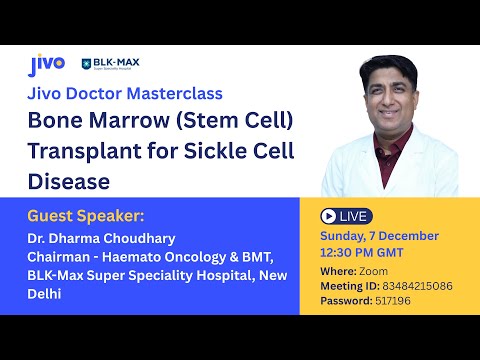
Dr. Dharma Choudhary
Chairman - Haemato Oncology & BMT
Centre For Bone Marrow Transplant, Lymphoma Cancer Programme, Bone Marrow Harvest, Lymphoma BMT Cancer Program, Haematology & BMT, Allogeneic Bone Marrow Transplant, Autologous Bone Marrow Transplant
BLK-Max Super Speciality Hospital, New Delhi, India
Conducted a Jivo Masterclass on 7 December 2025
Bone Marrow (Stem Cell) Transplant for Sickle Cell Disease
Book a consultation with Dr. Dharma Choudhary
Share your reports on WhatsApp. The Jivo team connects you with Dr. Dharma Choudhary’s team. Or message us on +91 98182 98669.

Dr. Vikas Dua
Principal Director & Head - Pediatric Hematology, Hemato Oncology & Bone Marrow Transplant
Haematology | Paediatric Haematology and BMT; Oncology | Hemato-Oncology; Paediatrics | Paediatric Oncology; Organ Transplant | Haematology and BMT
Fortis Memorial Research Institute, Gurgaon, India
Conducted a Jivo Masterclass on 28 July 2024
BMT in Sickle Cell Anaemia and Other Haematological Disorders

Book a consultation with Dr. Vikas Dua
Share your reports on WhatsApp. The Jivo team connects you with Dr. Vikas Dua’s team. Or message us on +91 98182 98669.

Dr. Divya Doval
Principal Consultant - Haemato Oncology & BMT
Centre For Bone Marrow Transplant, Bone Marrow Harvest, Haematology & BMT, Allogeneic Bone Marrow Transplant, Autologous Bone Marrow Transplant
BLK-Max Super Speciality Hospital, New Delhi, India
Conducted a Jivo Masterclass on 24 November 2024
Diagnosis and Management of Sickle Cell Disease

Book a consultation with Dr. Divya Doval
Share your reports on WhatsApp. The Jivo team connects you with Dr. Divya Doval’s team. Or message us on +91 98182 98669.

Dr. Arun Singh Danewa
Senior Consultant – Pediatric-Haemato-Oncology & Bone Marrow Transplant (Unit II)
BMT, Hematology, Oncology, Paediatric Haemato-Oncology & BMT
Artemis Hospitals, Gurugram, India
Conducted a Jivo Masterclass on 2 September 2026
Sickle Cell Disease and Bone Marrow Transplant

Book a consultation with Dr. Arun Singh Danewa
Share your reports on WhatsApp. The Jivo team connects you with Dr. Arun Singh Danewa’s team. Or message us on +91 98182 98669.

Dr. Sukriti Gupta
Sr. Consultant
BMT, Haematopoietic Stem Cell Transplant, Hematology, Oncology, Paediatric Haemato-Oncology & BMT
Artemis Hospitals, Gurugram, India
Conducted a Jivo Masterclass on 9 November 2025
Diagnosis and Management of Sickle Cell Disease

Book a consultation with Dr. Sukriti Gupta
Share your reports on WhatsApp. The Jivo team connects you with Dr. Sukriti Gupta’s team. Or message us on +91 98182 98669.
This page is general information, not medical advice.
Next steps
Chat with Jivo on WhatsAppOr message us on WhatsApp: +91 98182 98669
Ask your doctor to join Jivo: your doctor stays your guide, and Jivo connects them with these specialists.